
Blogs
Melasma Keeps Coming Back — Here’s Why (and What Actually Helps)
If your melasma improves with treatment, only to return a few weeks or months later, you’re not alone.
One of the most common things I hear from patients with melasma is:
“Doctor, it had completely cleared. Why has it come back?”
The answer is important because it changes the way we approach treatment.
Melasma is not simply pigmentation that needs to be removed once. It is a chronic, relapsing skin condition that needs to be managed.
And understanding that at the beginning can save you from years of jumping from one cream, peel or laser to another.
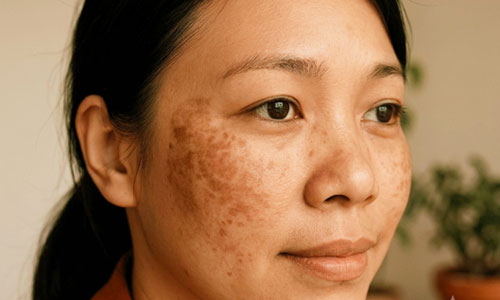
What Exactly Is Melasma?
Melasma appears as brown to grey-brown patches of pigmentation, most commonly on the:
- Cheeks
- Forehead
- Upper lip
- Nose
- Chin
It is particularly common in women and in people with medium to deeper skin tones, including Indian skin.
But melasma is more complex than simply having “extra pigment.”
Several biological processes appear to be involved, including increased melanin production, changes in the skin’s response to light and, in some patients, alterations involving blood vessels and the deeper layers of the skin.
This is one reason why melasma can be frustratingly persistent.
Why Does Melasma Keep Coming Back?
1. Sunlight Is a Major Trigger
Ultraviolet radiation stimulates pigment-producing cells called melanocytes.
Even relatively small amounts of repeated sun exposure can contribute to melasma recurrence.
And sunscreen applied only when you are going to the beach is not enough.
For someone prone to melasma, daily photoprotection is part of treatment — not an optional skincare step.
2. Visible Light Matters Too
We traditionally focused heavily on ultraviolet radiation, but visible light can also contribute to pigmentation, particularly in darker skin types.
This is why, in selected patients with melasma, I may recommend a tinted sunscreen containing iron oxides rather than relying only on conventional sunscreen.
The best sunscreen for melasma isn’t necessarily the fanciest one.
It is the one that provides appropriate protection and that you are willing to apply consistently and adequately.
3. Heat May Be a Trigger
Many patients notice their melasma worsening after repeated heat exposure.
This doesn’t mean you need to avoid stepping outside or live in an air-conditioned room.
But if you notice that prolonged heat exposure consistently worsens your pigmentation, it is worth recognising it as a possible trigger.
4. Hormones Can Play a Role
Melasma commonly appears or worsens during pregnancy, which is why it has historically been called the “mask of pregnancy.”
Hormonal medications can also influence pigmentation in susceptible individuals.
However, not every patient with melasma has an identifiable hormonal problem.
You don’t necessarily need an extensive hormonal work-up simply because you have melasma. Your dermatologist will decide whether further evaluation is appropriate based on your history and other symptoms.
5. Genetics Matter
If melasma runs in your family, you may have a greater tendency to develop it.
Unfortunately, we cannot change our genetics.
What we can change is how aggressively we manage the environmental and behavioural factors that trigger pigmentation.
Why Did My Pigmentation Come Back After I Stopped the Cream?
Because the cream may have controlled melanin production without eliminating your underlying tendency to develop melasma.
Think of melasma less like an infection that is treated and finished, and more like a condition that often requires long-term control and maintenance.
Your intensive treatment phase and your maintenance phase may therefore look very different.
This is also why stopping every component of treatment immediately after the pigmentation improves can sometimes lead to recurrence.
Which Ingredients Actually Help Melasma?
Depending on the patient, dermatologists may use ingredients such as:
- Hydroquinone
- Azelaic acid
- Retinoids
- Tranexamic acid
- Kojic acid
- Cysteamine
- Other pigment-modulating agents
But there is an important caveat:
More actives do not necessarily mean faster results.
Irritating the skin with multiple acids, scrubs and strong active ingredients can worsen inflammation and sometimes make pigmentation more difficult to manage.
Melasma treatment needs patience.
What About Hydroquinone?
Hydroquinone is one of the most established treatments for melasma and can be extremely useful when prescribed appropriately.
Unfortunately, it has developed a somewhat confusing reputation online.
Hydroquinone is neither something everyone with pigmentation should start using on their own nor an ingredient that automatically needs to be feared.
Its concentration, duration of use, combination with other medications and maintenance strategy matter.
This is one ingredient I would particularly avoid self-prescribing for months or years without medical supervision.
Does Tranexamic Acid Treat Melasma?
Tranexamic acid has become increasingly important in melasma management.
It may be used topically, orally or through certain procedures depending on the clinical situation.
However, oral tranexamic acid is a medication — not a skincare supplement.
It is not suitable for everyone and requires appropriate medical history and risk assessment before prescription.
Seeing it recommended on social media does not mean it should be taken without supervision.
Do Chemical Peels Help?
Chemical peels can be useful in selected patients, particularly as part of a broader treatment plan.
But aggressive peeling is not the goal.
With Indian skin, excessive inflammation can itself lead to post-inflammatory hyperpigmentation, potentially making the problem worse.
The correct peel, concentration, frequency and patient selection matter far more than how dramatically your skin peels afterwards.
What About Lasers for Melasma?
This is where expectations become particularly important.
Lasers and energy-based devices can have a role in carefully selected cases, especially resistant melasma.
But melasma is not simply a pigment that can always be lasered away permanently.
Inappropriate or overly aggressive laser treatment can sometimes trigger rebound pigmentation or post-inflammatory hyperpigmentation.
So if somebody promises to permanently remove your melasma with a few laser sessions, be cautious.
A device is a tool.
It is not a substitute for understanding the disease.
Why “Quick-Fix” Melasma Treatments Can Backfire
Patients with melasma are understandably tempted by treatments promising dramatic improvement within days.
Unfortunately, some unregulated fairness or pigmentation creams may contain potent steroids or inappropriate combinations.
They may initially make the skin appear lighter.
With prolonged or unsupervised use, however, they can cause problems such as:
- Skin thinning
- Visible blood vessels
- Acne-like eruptions
- Increased sensitivity
- Rebound pigmentation
- Steroid-dependent facial skin
If a pigmentation cream gives unusually rapid results and you don’t know what it contains, that is a reason to be cautious — not impressed.
The Most Underrated Melasma Treatment: Maintenance
This is perhaps the most important part of this article.
Many patients are very disciplined while treating melasma and stop everything once their skin looks better.
But melasma management doesn’t necessarily end when the pigmentation improves.
A maintenance plan may include:
- Consistent sun protection
- Appropriate skincare
- Selected pigment-control ingredients
- Trigger management
- Periodic review with your dermatologist
The objective is to keep your skin stable while using the minimum treatment necessary to maintain the improvement.
Can Melasma Be Permanently Cured?
I prefer not to promise patients a permanent cure.
Melasma can often be controlled extremely well, and significant improvement is possible.
But because the underlying tendency can remain, pigmentation may recur after sun exposure, hormonal changes or other triggers.
Understanding this doesn’t make treatment pointless.
It makes treatment realistic.
Instead of repeatedly “starting from zero” every time pigmentation returns, the aim is to achieve good control and then maintain it.
What I Want Patients With Melasma to Know
If you have been struggling with melasma for years, don’t assume that you simply haven’t found a strong enough cream or powerful enough laser.
Sometimes the problem is the approach itself.
Melasma management is usually a combination of:
Protection + treatment + patience + maintenance.
And perhaps the biggest mistake is treating only the pigmentation you can see while ignoring the tendency of your skin to produce it again.
So rather than asking:
“How do I remove my melasma?”
A better question may be:
“How do I get my melasma under control — and keep it there?”
That is where good long-term treatment begins.
Frequently Asked Questions
Why does my melasma keep coming back?
Melasma has a tendency to recur because factors such as sunlight, visible light, hormones, genetics and other triggers can continue stimulating pigmentation even after treatment has improved its appearance.
Which sunscreen is best for melasma?
Broad-spectrum sun protection is essential. In selected patients, tinted sunscreens containing iron oxides may provide additional protection against visible light. Your dermatologist can recommend an appropriate formulation for your skin.
Can melasma be permanently removed with laser?
Lasers may help selected patients but should not generally be considered a guaranteed permanent cure for melasma. Incorrect or aggressive treatment can sometimes worsen pigmentation.
Is hydroquinone safe for melasma?
Hydroquinone can be an effective treatment when prescribed and monitored appropriately. Long-term unsupervised use should be avoided.
Can melasma get worse during pregnancy?
Yes. Hormonal changes during pregnancy can trigger or worsen melasma in susceptible individuals. Treatment options during pregnancy are more limited, so treatment should be discussed with your dermatologist.
How long does melasma treatment take?
Improvement is gradual and varies considerably between patients. Melasma often requires an initial treatment phase followed by longer-term maintenance rather than a short course of treatment.
Medical Disclaimer
This article is intended for general educational purposes only and does not replace an individual consultation with a dermatologist. Treatment for melasma should be selected according to your skin type, medical history, medications, pregnancy status and clinical examination.